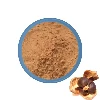
As agriculture moves toward more sustainable and resource-efficient production systems, plant-derived materials are gaining attention as alternatives and complements to conventional agricultural inputs. Tea Seed Meal Powder is one such material, produced from the seeds of Camellia oleifera after oil extraction.
Tea Seed Meal contains organic matter, proteins, fiber, minerals, and naturally occurring saponins and tannins. These characteristics make it a useful raw material for organic fertilizer, composting, soil amendments, and other agricultural formulations. Recent research continues to investigate the composition and potential applications of Camellia oleifera seed meal and its saponins.
For farmers, fertilizer manufacturers, and agricultural-product suppliers, Tea Seed Meal Powder can provide a plant-derived source of organic material while also supporting the utilization of an agricultural processing by-product.
What Is Tea Seed Meal Powder?
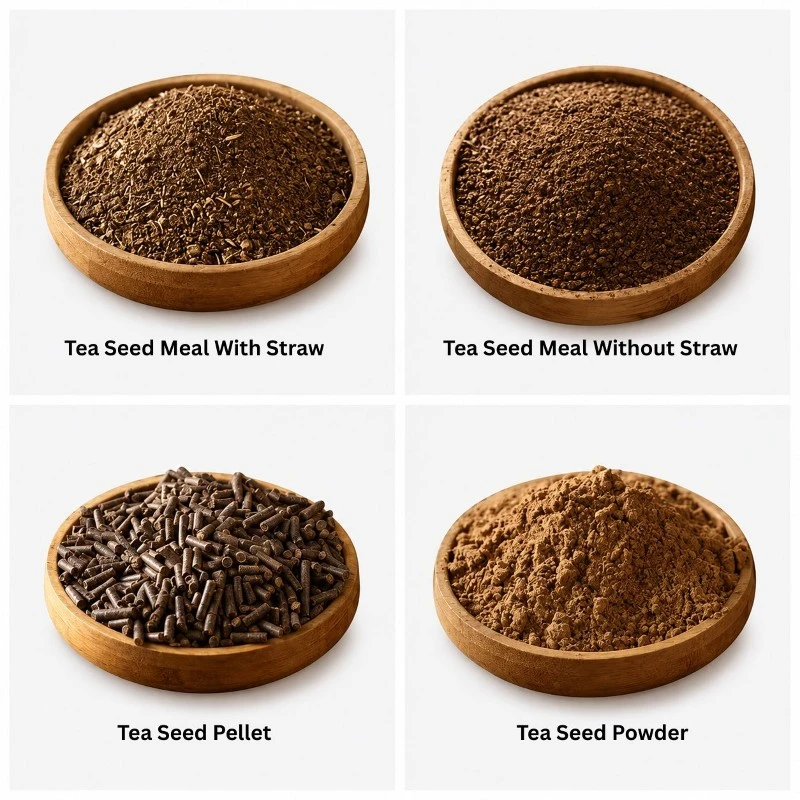
Tea Seed Meal Powder is produced from the solid residue remaining after oil is extracted from Camellia oleifera seeds.
The material is sometimes called tea seed cake or tea seed meal. After appropriate drying and milling, it can be processed into a powder or granular agricultural raw material.
Its composition can vary according to the seed source and oil-extraction process, but Tea Seed Meal generally contains:
- Organic matter
- Protein
- Fiber
- Mineral nutrients
- Naturally occurring tea saponins
- Tannins and other plant compounds
Tea saponins are particularly important because they are naturally occurring surface-active compounds found in Camellia oleifera seed meal. A 2025 review described tea seed meal as a rich source of tea saponins and highlighted their potential applications in environmental management and other fields.

Why Use Tea Seed Meal Powder for Agriculture?
Tea Seed Meal Powder can be valuable as a multifunctional agricultural raw material rather than simply as a conventional fertilizer.
Its potential agricultural value comes from several characteristics.
1. Plant-Derived Organic Matter
Tea Seed Meal contains organic components originating from the Camellia oleifera seed.
When incorporated into an appropriate fertilizer or composting system, this organic material can contribute to the organic fraction of the finished agricultural product.
Organic materials are commonly used in soil-management programs to complement mineral fertilizers and support long-term soil fertility strategies.
However, Tea Seed Meal should not automatically be considered a complete fertilizer because its nutrient profile varies and may not provide all nutrients required by a crop in balanced proportions.
2. Contains Nutritional Elements
Tea Seed Meal contains nitrogen and mineral components, although concentrations depend on the raw material and processing conditions.
Research examining the composting of Camellia oleifera seed cake found that total nitrogen, phosphorus, potassium, and total nutrient concentrations changed during the composting process.
This makes Tea Seed Meal particularly interesting as a component of organic fertilizer blends.
For commercial fertilizer production, however, the actual nutrient content should be determined through laboratory analysis rather than assumed from general specifications.
3. Suitable for Composting
One of the important applications of Tea Seed Meal Powder is as a raw material for composting.
Raw Camellia oleifera seed cake contains saponins and tannins. During controlled composting, microorganisms and environmental changes can break down these compounds.
A 2020 PLOS ONE study found that tannin and saponin contents decreased during co-composting of Camellia oleifera shell and seed cake. The researchers also observed changes in nitrogen and other nutrient parameters as composting progressed.
This makes composting an important method for converting Tea Seed Meal and related processing residues into a more stabilized agricultural material.
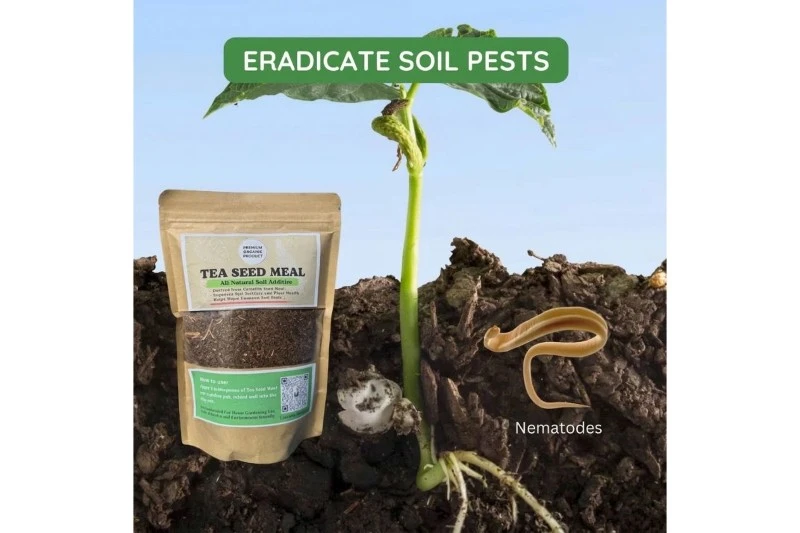
Tea Seed Meal Powder and Soil Improvement
The use of Tea Seed Meal Powder in soil-management programs can be considered from several perspectives.
Improving Organic Inputs to Soil
Tea Seed Meal adds plant-derived organic material to fertilizer and soil-amendment formulations.
When properly processed and applied, it can complement other organic materials such as compost, plant residues, manure-derived compost, or other botanical fertilizer ingredients.
The goal is generally to improve the overall quality of the soil-management program rather than relying on Tea Seed Meal as the only input.
Supporting Compost-Based Soil Management
Composted Tea Seed Meal can be incorporated into organic fertilizer programs.
Composting changes the physical and chemical characteristics of the original seed cake. In the 2020 study, the compost reached maturity indicators associated with reduced tannin and saponin concentrations, while nutrient-related parameters changed during decomposition.
This distinction is important: raw Tea Seed Meal and mature Tea Seed Meal-based compost should not automatically be treated as the same agricultural product.
Natural Saponin Content
Tea Seed Meal naturally contains tea saponins.
Tea saponins have surface-active properties and have been investigated for applications related to soil remediation and environmental management. Research has examined their ability to interact with soil components and influence the availability of certain compounds.
This gives Tea Seed Meal an additional functional characteristic compared with many conventional organic fertilizer materials.
However, the presence of saponins does not mean that every Tea Seed Meal product will have the same soil effect. Saponin concentration and product processing must be evaluated.
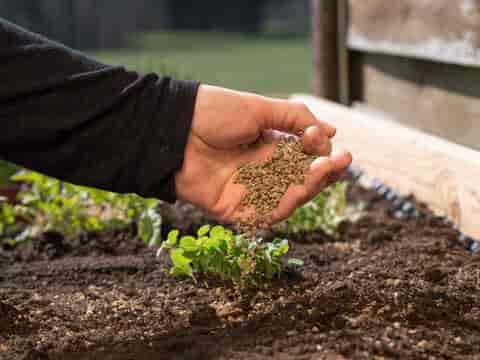
Tea Seed Meal Powder for Organic Fertilizer
Tea Seed Meal Powder can be incorporated into different types of organic fertilizer formulations.
Granular Organic Fertilizer
Tea Seed Meal Powder can be blended with other organic materials and processed into granules.
Granulation can improve handling, transportation, storage, and field application.
Powdered Organic Fertilizer
Fine Tea Seed Meal Powder can also be used directly as a raw material in powdered fertilizer formulations.
Particle size should be controlled to provide consistent mixing and distribution.
Compost-Based Fertilizer
Tea Seed Meal can be composted together with other organic materials.
The composting process can reduce naturally occurring tannins and saponins and produce a more stabilized material suitable for fertilizer applications.
Soil Amendment Products
Tea Seed Meal can also be included in soil-amendment formulations where plant-derived organic material is desired.
The finished product should be evaluated according to its intended crop, soil type, nutrient content, and application method.
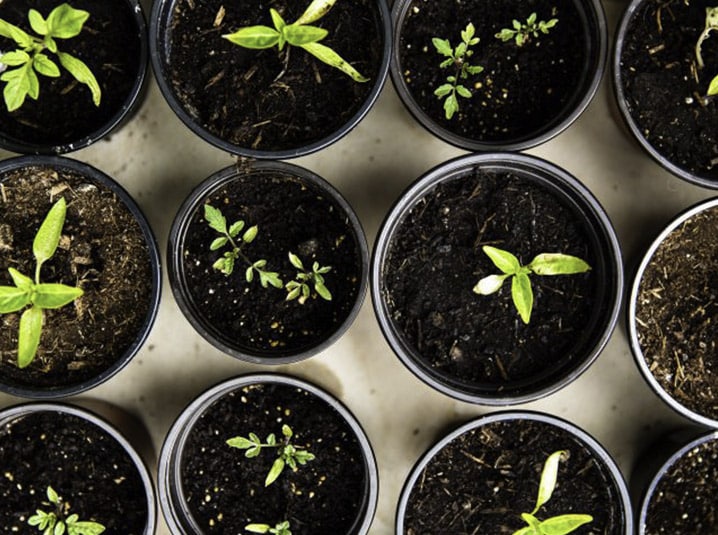
Tea Seed Meal Powder for Crop Production
Tea Seed Meal Powder may be incorporated into agricultural programs for various crop categories, including:
- Vegetables
- Fruits
- Field crops
- Horticultural crops
- Nursery plants
- Ornamental plants
- Plantation crops
- Organic farming systems
The appropriate application method will vary according to the product specification and crop requirements.
For commercial use, field trials can help determine how a particular Tea Seed Meal formulation performs under local soil and climate conditions.
Raw Tea Seed Meal vs. Composted Tea Seed Meal
This is an important consideration when using Tea Seed Meal for agriculture.
Raw Tea Seed Meal
Raw Tea Seed Meal contains naturally occurring saponins and tannins. Depending on the concentration, these compounds can influence biological activity.
Therefore, direct agricultural application should be based on the specific product specification and crop tolerance.
Composted Tea Seed Meal
During controlled composting, microorganisms can break down organic compounds and reduce saponin and tannin concentrations.
In the PLOS ONE study, saponin and tannin levels progressively declined during composting, while the compost maturity indicators improved.
For this reason, composted Tea Seed Meal may have different agricultural characteristics from the original raw material.
How Tea Seed Meal Powder Supports Sustainable Agriculture
Tea Seed Meal is a good example of agricultural by-product utilization.
Camellia oleifera seeds are processed primarily for oil production. The remaining seed meal can otherwise become an underutilized residue.
Using this material for fertilizer and soil-related applications creates a pathway for converting an agricultural processing by-product into a useful input.
The 2025 review of Camellia oleifera seed meal saponins specifically highlights the potential for higher-value utilization of seed meal and the broader sustainability of the Camellia oleifera industry.
This circular approach is particularly relevant to manufacturers developing plant-based fertilizer and soil-management products.
Important Quality Factors for Tea Seed Meal Powder
For commercial agricultural applications, quality consistency is essential.
Saponin Content
Saponin concentration can vary between Tea Seed Meal products. Testing the actual level helps manufacturers determine how the product should be used.
Organic Matter
Organic matter is an important specification when the material is intended for fertilizer or soil-amendment applications.
Nutrient Content
Nitrogen, phosphorus, potassium, and other relevant nutrients should be measured rather than estimated.
Moisture
Moisture content affects storage stability, transportation, flowability, and the risk of microbial deterioration.
Particle Size
Consistent particle size helps improve mixing and distribution in fertilizer formulations.
Purity
The product should be tested for relevant contaminants, including heavy metals and other parameters required for the intended agricultural market.
Batch Consistency
Commercial fertilizer manufacturers need consistent raw materials so that the finished formulation performs predictably.
A professional supplier should be able to provide a COA, specification sheet, SDS/MSDS, and relevant testing documentation.
How Much Tea Seed Meal Powder Should Be Used?
There is no single application rate suitable for every crop, soil, or Tea Seed Meal product.
Application should depend on:
- Product nutrient analysis
- Saponin concentration
- Processing method
- Soil condition
- Crop species
- Crop growth stage
- Application method
- Other fertilizer inputs
- Local agricultural requirements
Research results should not automatically be converted into commercial application rates.
For new formulations, manufacturers can conduct laboratory, greenhouse, and field trials to determine an appropriate inclusion or application level.
Is Tea Seed Meal Powder a Complete Fertilizer?
Tea Seed Meal Powder is better considered an organic fertilizer ingredient or soil-amendment material rather than a universal complete fertilizer.
A complete crop nutrition program may require additional nitrogen, phosphorus, potassium, secondary nutrients, and micronutrients depending on soil conditions and crop requirements.
Tea Seed Meal can therefore be combined with other organic or mineral fertilizer ingredients to create a more balanced formulation.
This approach also allows manufacturers to standardize the final nutrient profile according to the target crop and market.

Tea Seed Meal Powder for Modern Agriculture
The agricultural industry is increasingly looking for ingredients that combine functionality, sustainability, and efficient resource utilization.
Tea Seed Meal Powder fits this direction because it combines a plant-derived organic matrix with naturally occurring saponins and other botanical compounds.
Its applications can extend across:
Organic fertilizer:
Used as a plant-derived ingredient in fertilizer blends.
Soil amendment:
Provides organic material for soil-management formulations.
Composting:
Can be processed with other organic materials to produce stabilized compost.
Crop production:
Can be incorporated into crop-specific fertilizer programs.
Agricultural by-product utilization:
Creates a higher-value use for the residue from Camellia oleifera oil production.
Conclusion
Tea Seed Meal Powder for Fertilizer and Soil Improvement offers a practical way to utilize a plant-derived agricultural by-product in modern soil and crop-management systems.
Its organic matter, nutrient components, naturally occurring saponins, and suitability for composting make it a versatile raw material for organic fertilizer, soil amendments, compost-based products, and agricultural formulations.
One of its most important advantages is its potential for sustainable resource utilization. Instead of treating Camellia oleifera seed meal only as an oil-processing residue, it can be processed and incorporated into agricultural products.
For commercial applications, however, product quality and processing method are critical. Saponin content, nutrient profile, moisture, particle size, purity, and batch consistency should all be evaluated before formulation.
With appropriate processing, testing, and crop-specific application strategies, Tea Seed Meal Powder can serve as a valuable botanical ingredient for fertilizer production and sustainable soil management.
References
Zhang, J., Liu, J., Wang, J., et al. (2025). Advances in Camellia oleifera seed meal Saponins: Extraction, analysis, bioactivity, and application. Food Chemistry, 492, 145277.
Zhang, J., Ying, Y., Li, X., & Yao, X. (2020). Changes in tannin and saponin components during co-composting of Camellia oleifera Abel shell and seed cake. PLOS ONE, 15(3), e0230602.
Yu, X.-L., & He, Y. (2018). Tea saponins: effective natural surfactants beneficial for soil remediation, from preparation to application. RSC Advances, 8, 24312–24321.
FAQ
Q1: What is Tea Seed Meal Powder?
A1: Tea Seed Meal Powder is produced from the solid residue left after oil extraction from Camellia oleifera seeds. It contains organic matter, protein, fiber, minerals, naturally occurring saponins, tannins, and other plant compounds, making it a useful raw material for agricultural formulations.
Q2: What is Tea Seed Meal also called?
A2: Tea Seed Meal is also commonly known as tea seed cake or tea seed meal. After drying and milling, it can be processed into powder or granular agricultural raw materials.
Q3: What are the main components of Tea Seed Meal Powder?
A3: Tea Seed Meal generally contains organic matter, protein, fiber, mineral nutrients, tea saponins, tannins, and other naturally occurring plant compounds. Its exact composition can vary according to seed source and oil-extraction conditions.
Q4: Can Tea Seed Meal Powder be used as an organic fertilizer ingredient?
A4: Yes. Tea Seed Meal Powder can be incorporated into organic fertilizer blends as a plant-derived source of organic material and nutrients. However, it should not automatically be considered a complete fertilizer because its nutrient profile may not provide all nutrients required by crops in balanced proportions.
Q5: Does Tea Seed Meal Powder contain nitrogen and other nutrients?
A5: Yes. Tea Seed Meal contains nitrogen and mineral components, although their concentrations depend on the raw material and processing conditions. Nitrogen, phosphorus, potassium, and other nutrients should be confirmed through laboratory analysis before commercial formulation.
Q6: Can Tea Seed Meal Powder be used for composting?
A6: Yes. Tea Seed Meal is a suitable raw material for composting. During controlled composting, microorganisms can break down naturally occurring compounds such as saponins and tannins while the nutrient characteristics of the material change as decomposition progresses.
Q7: What is the difference between raw and composted Tea Seed Meal?
A7: Raw Tea Seed Meal naturally contains saponins and tannins, while controlled composting can reduce the concentrations of these compounds and produce a more stabilized agricultural material. Therefore, raw Tea Seed Meal and mature Tea Seed Meal-based compost should not automatically be treated as the same product.
Q8: Can Tea Seed Meal Powder improve soil?
A8: Tea Seed Meal can contribute plant-derived organic material to soil-management and soil-amendment formulations. It can be combined with compost, plant residues, manure-derived compost, and other botanical materials as part of a broader soil-management program.
Q9: What role do tea saponins play in Tea Seed Meal Powder?
A9: Tea saponins are naturally occurring surface-active compounds found in Camellia oleifera seed meal. Their surface-active properties give Tea Seed Meal an additional functional characteristic and have been investigated for soil-remediation and environmental-management applications.
Q10: Can Tea Seed Meal Powder be used in organic fertilizer formulations?
A10: Yes. It can be incorporated into powdered organic fertilizers, granular fertilizer blends, compost-based fertilizers, and soil-amendment products. The finished formulation should be evaluated according to its nutrient content, intended crop, soil conditions, and application method.