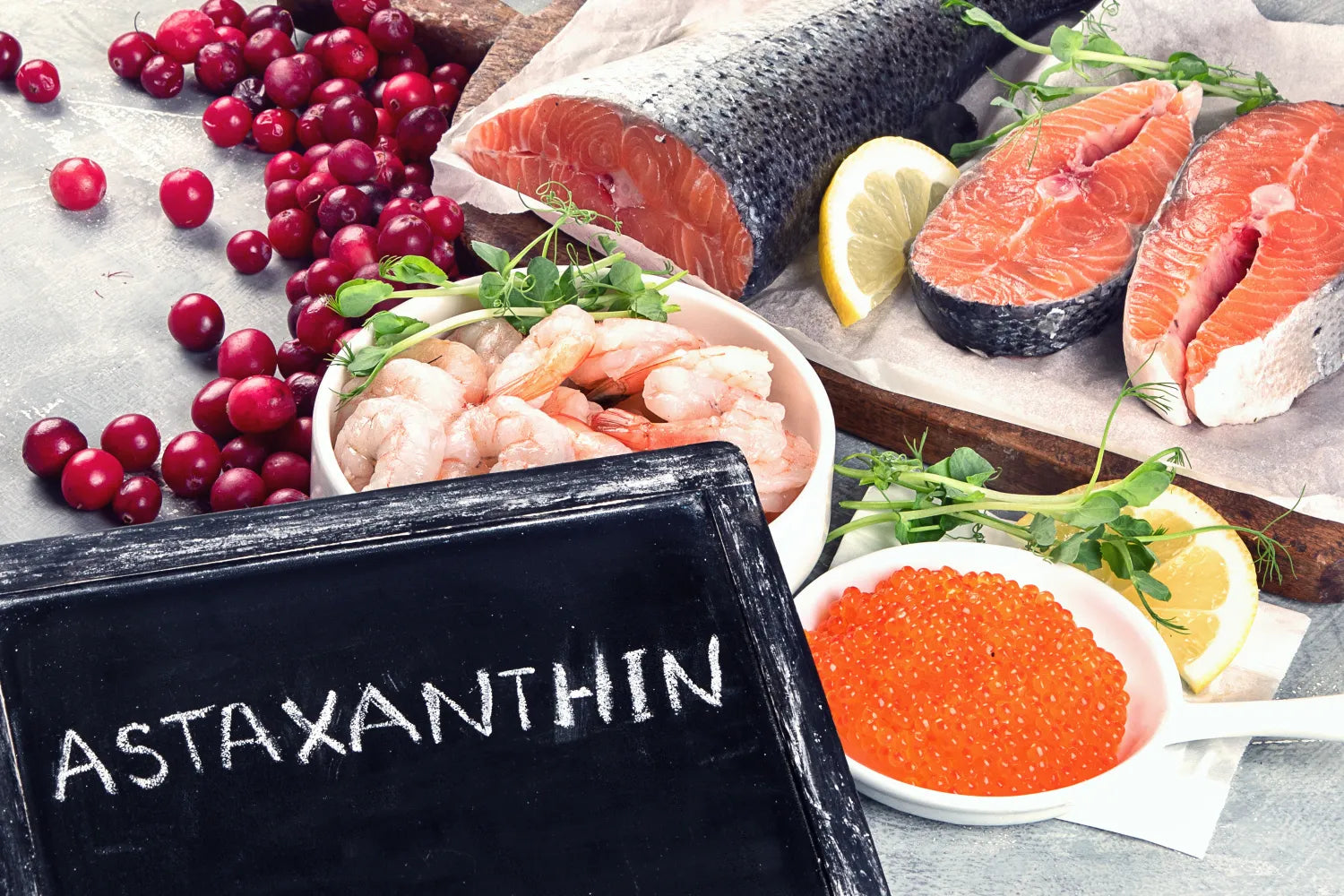
Astaxanthin is the most powerful natural antioxidant found in nature. Astaxanthin is a reddish-orange carotenoid pigment responsible for the pink and red hues of salmon, shrimp, krill, and flamingos. Astaxanthin is distinct from the majority of other carotenoids because it contains special structural and biological properties that qualify it as a great cell protector against oxidative stress and inflammation. Over the last two decades, astaxanthin has emerged as a constantly increasing concern in the domains of animal health, aquaculture, poultry, and pet food because of its broad spectrum of benefits.
The next blog speaks about what astaxanthin is, how it works, and why it is such a valuable supplement for improving animal health, productivity, and overall performance.

What Is Astaxanthin?
Astaxanthin belongs to the class of organic carotenoid natural pigments. While beta-carotene and lutein are both highly known as antioxidants, astaxanthin is distinguished by being roughly 10 times stronger than beta-carotene and 100 times stronger than vitamin E in their ability to kill free radicals (Ambati et al., 2014).
It is produced naturally by the microalgae (Haematococcus pluvialis) as a protective response to stress in the environment. Zooplankton, krill, and fish feeding on such algae store the pigment in their bodies. Therefore, flamingos and salmon obtain their characteristic colorations.
Astaxanthin is industrially produced by culturing microalgae, krill, or yeast and applied widely in aquaculture feed, animal nutrition, and pet foods.

The Biological Role of Astaxanthin
Astaxanthin is a lipophilic antioxidant with an atypical molecular structure by which it gains the ability to enter the cell membrane. This makes it especially effective to protect intracellular and extracellular regions of cells from oxidative damage. Contrary to certain other antioxidants, under certain conditions they act as pro-oxidants, astaxanthin is stabilized and never acts as a pro-oxidant (Higuera-Ciapara et al., 2006).
Its major biological activities are:
- Neutralizing reactive oxygen species (ROS) and free radicals.
- Preventing lipid, protein, and DNA oxidation.
- Assisting in the regulation of the immune system.
- Preventing inflammation.
- Enhancing resistance of tissues to stress and infection.

Benefits of Astaxanthin for Aquaculture
Astaxanthin is utilized most commonly in aquaculture, where it serves a dual function: pigmentation and enhancement of fish health.
1. Pigmentation
Salmon and trout fish require astaxanthin to achieve their normal flesh color of pink-red, and consumer acceptability depends on it. Astaxanthin in diets ensures consistent color in farmed populations (Christiansen et al., 1995).
2. Growth and Survival
Supplementation with astaxanthin improved growth performance, feed efficiency, and fish survival. Astaxanthin increases resistance to abiotic stress factors such as stocking density and temperature stress (Pan et al., 2011).
3. Immune Support
By increasing antioxidant activity and avoidance of oxidative stress, astaxanthin improves immune functions in fish, promoting resistance to bacterial, viral, and parasitic infection.
Benefits of Astaxanthin in Poultry
Astaxanthin is being increasingly utilized in poultry culture as a health improver as well as coloring substance.
1. Pigmentation of Egg Yolk
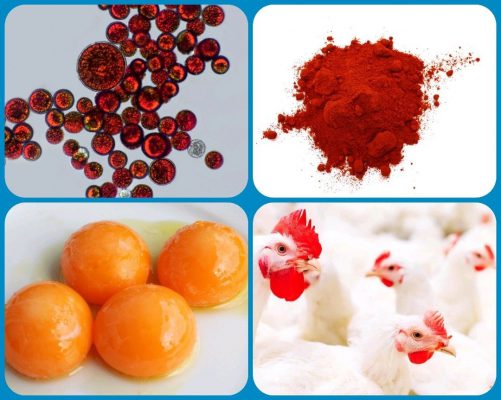
Customers want golden egg yolks. Addition of astaxanthin to egg layers increases yolk coloration with no need for artificial pigments (Surai et al., 2020).
2. Antioxidant Defense
Poultry experience heat stress, which increases oxidative stress and leads to a loss of productivity. Astaxanthin helps combat such conditions, upholding cellular defense as well as boosting laying performance.
3. Meat Quality
In broilers, astaxanthin enhances the quality of meat by inhibiting lipid peroxidation and maintaining freshness and shelf life.
Advantages of Astaxanthin in Livestock
Less common in cattle, pigs, and other livestock than poultry or aquaculture, astaxanthin is still under increasing scrutiny.
1. Fertility and Reproductive Health
Oxidative stress may jeopardize the fertility of males and females. Astaxanthin has been linked to improved sperm quality and ovarian function and thus is beneficial in animal breeding (Moura et al., 2011).
2. Immunity and Stress
In pigs and livestock, astaxanthin supplementation reduces transport-induced oxidative stress, environmental stress, and challenge of disease. Immune functions are also boosted and reduced susceptibility to infection.
Benefits of Astaxanthin to Pets
Pet owners are also employing natural supplements as a way of prolonging the health and lifespan of their dogs and cats. Astaxanthin is safe and beneficial in companion animals.
1. Joint Health
Cats and dogs naturally develop arthritis and joint inflammation as they age. Astaxanthin's anti-inflammatory potential reduces pain, stiffness, and mobility impairment (Park et al., 2010).
2. Skin and Coat Health
Astaxanthin supports healthy skin through the reduction of oxidative stress in skin cells. It improves coats and soothes skin irritations.
3. Eye Health
Pets develop cataracts or other eye diseases when the animal becomes old. Astaxanthin protects the retinal cells and supports healthy eyes since it crosses the blood-retina barrier.
4. Immune Support
Astaxanthin supports the immune system, and thus pets become less susceptible to infection and aging.
How Astaxanthin Acts at the Cellular Level
It is because of its molecular structure that astaxanthin is such a potent antioxidant. It has polar ends that actually interact with cell membranes and a long chain that extends across the lipid bilayer. This makes it able to shield cells from both sides.
Some antioxidants like vitamin C act only in water-soluble medium, and vitamin E acts only in fat-soluble medium. Bi-solubility of astaxanthin makes it possible to provide full antioxidant protection and it is one of the best antioxidants for use in animals.

Safety and Dosage Considerations
Astaxanthin is not toxic to animals at the dosage levels recommended. In aquaculture, 25–100 mg/kg of diet is added. Poultry needs lower concentrations (10–30 mg/kg) in order to attain pigmentation and health benefits.
Pet food supplements sold commercially typically include dosages ranging from 2–8 mg/day per unit weight. Standard levels of supplementation have not been associated with side effects, except that ultra-high levels should be avoided.
The Future of Astaxanthin in Animal Nutrition
With escalating need for naturality and sustainability, the use of astaxanthin in animal feed will further expand. Its multi-purpose characteristics-coloring, antioxidant protection, immunity enhancement, and productivity enhancement-render it an attractive additive.
Greater research will be able to uncover further applications in animal agriculture, pet well-being, and even veterinary practice. Advances in the production of microalgae will reduce the cost of production, thereby boosting the supply of astaxanthin for further applications.
Conclusion
Astaxanthin is more than a simple natural pigment. It's a very potent antioxidant and anti-inflammatory agent with a wide variety of uses in aquaculture, poultry, livestock, and pets. Ranging from fish coloration and egg yolk pigmentation to joint health in dogs and fertility in livestock, astaxanthin has become an animal nutrition and health formulation first choice.
Its recently acquired cellular protection, coupled with its natural origin, makes astaxanthin the foundation supplement for future sustainable pet and animal health.
References
Ambati, R. R., Moi, P. S., Ravi, S., & Aswathanarayana, R. G. (2014). Astaxanthin: Sources, extraction, stability, biological activities and its commercial applications-A review. Marine Drugs, 12(1), 128-152. https://doi.org/10.3390/md12010128
Christiansen, R., Lie, Ø., & Torrissen, O. J. (1995). Growth and survival of Atlantic salmon (Salmo salar L.) fed different dietary levels of astaxanthin. Aquaculture Nutrition, 1(2), 77-84. https://doi.org/10.1111/j.1365-2095.1995.tb00025.x
Higuera-Ciapara, I., Félix-Valenzuela, L., & Goycoolea, F. M. (2006). Astaxanthin: A review of its chemistry and applications. Critical Reviews in Food Science and Nutrition, 46(2), 185–196. https://doi.org/10.1080/10408690590957188
Moura, C. S., Leme, L. O., & Barros, P. M. (2011). Antioxidant effects on reproduction: A review on astaxanthin. Reproduction in Domestic Animals, 46(2), 325–332. https://doi.org/10.1111/j.1439-0531.2010.01674.x
Pan, C. H., Chien, Y. H., & Wang, Y. J. (2011). Effects of dietary supplementation with astaxanthin on growth, survival, and stress resistance of fish larvae. Aquaculture Research, 42(6), 735-742. https://doi.org/10.1111/j.1365-2109.2010.02673.x
Park, J. S., Chyun, J. H., Kim, Y. K., Line, L. L., & Chew, B. P. (2010). Astaxanthin decreased oxidative stress and inflammation and enhanced immune response in humans. Nutrition & Metabolism, 7(1), 18. https://doi.org/10.1186/1743-7075-7-18
Surai, P. F., Kochish, I. I., & Kidd, M. T. (2020). Redox homeostasis in poultry: Regulatory roles of astaxanthin. Poultry Science, 99(4), 1463-1474. https://doi.org/10.1016/j.psj.2019.12.030