What Is Tea Saponin?
Tea saponin is a group of naturally occurring plant compounds found in several species of the Camellia genus. Commercial tea saponin is commonly obtained from the seeds and seed-processing residues of Camellia oleifera Abel, an oil-producing plant widely cultivated in China and other parts of Asia. The seeds are processed to produce camellia seed oil and after oil extraction, the remaining seed meal or seed cake contains valuable plant constituents, including tea saponins. It creates an opportunity to recover functional botanical compounds from agricultural processing residues and develop higher-value ingredients.
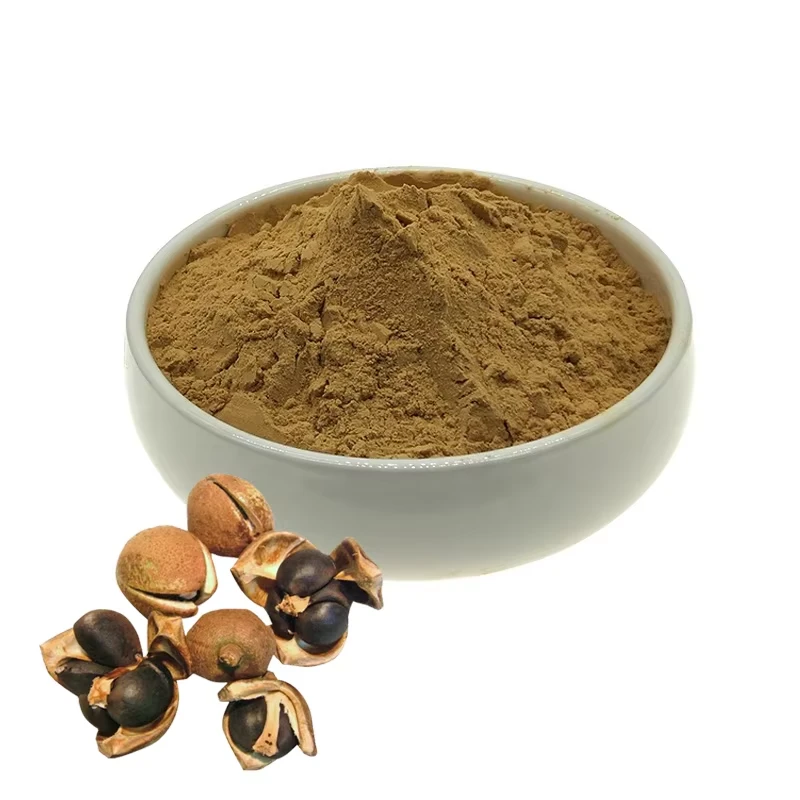
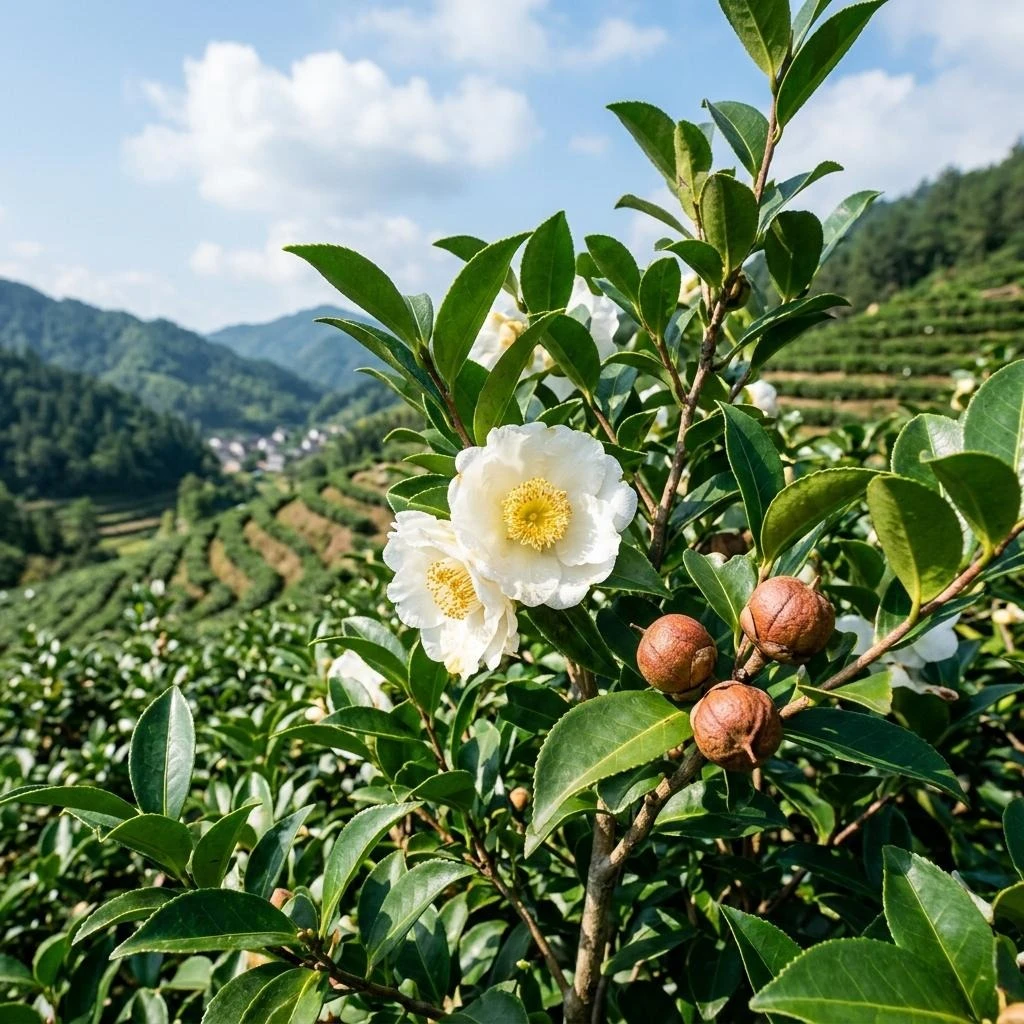
Tea saponin botanical origin from Camellia oleifera seeds and applications in animal nutrition.
Understanding Triterpenoid Saponins
Tea saponin belongs to a broader group of plant compounds called saponins. These are glycosides consisting of two major structural components:
- A hydrophobic aglycone, also called a sapogenin.
- One or more hydrophilic sugar chains attached to the aglycone.
This combination gives saponins their amphiphilic nature. One part of the molecule interacts more readily with oils and other nonpolar substances, while the other interacts with water.
What are triterpenoid saponins?
Triterpenoid saponins are triterpenes that belong to the group of saponin compounds. Triterpenes belong to a large group of compounds arranged in a four- or five-ring configuration of 30 carbons with several oxygens attached. Triterpenoid saponins are compounds whose aglycone portion is derived from a triterpenoid carbon skeleton.
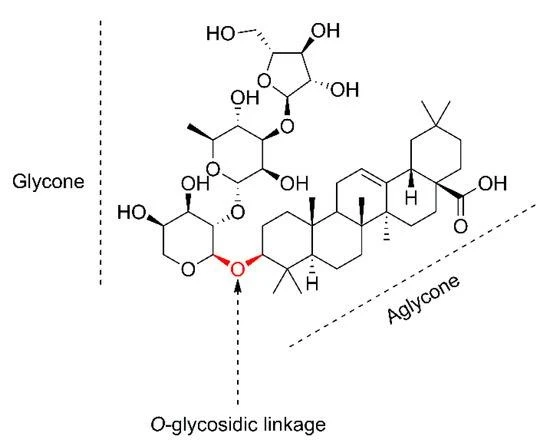
Tea saponins from Camellia are generally associated with pentacyclic, oleanane-type triterpenoid structures and their molecular structures can vary because of differences in:
- Hydroxyl and other oxygen-containing functional groups.
- Attached sugar units.
- Glycosidic linkage positions.
- Acetylation and other chemical modifications.
- Additional structural substitutions.
These differences contribute to the chemical diversity of tea saponins. While, commercial tea saponin is generally a mixture of related compounds rather than one chemically uniform molecule.
How does the structure influence functionality?
The hydrophobic triterpenoid portion can associate with lipid surfaces, while the hydrophilic sugar portion interacts with water.
This molecular arrangement helps explain why tea saponin can:
- Reduce surface and interfacial tension.
- Promote wetting and dispersion.
- Contribute to foam formation.
- Support emulsification.
- Interact with biological membranes.
- Influence the behavior of certain microorganisms.
For ingredient developers, this also explains why total saponin concentration alone may not provide a complete picture of product functionality. The individual saponin profile and proportions of different constituents can also matter.
Surface-Active Properties: What Makes Tea Saponin Different?
Tea saponin is known for its natural surface-active properties. Its amphiphilic structure allows it to interact with water-oil and water-air interfaces, giving it several useful physicochemical characteristics.
1. Emulsifying Properties
Tea saponin interacts with oil-water interfaces and can help stabilize dispersed oil droplets. This property is relevant to food processing, agricultural formulations, and animal feed development, particularly in lipid-containing feeds and premixes. Its actual emulsifying performance depends on the formulation.
2. Foaming Properties
Tea saponin reduces water's surface tension, promoting foam formation and stability. Its foaming behavior depends on concentration, temperature, pH, water hardness, and other ingredients, making these factors important in formulation development.
3. Wetting and Dispersing Properties
Tea saponin can improve surface wetting and help disperse materials in water-based systems. In feed manufacturing, this may be relevant to ingredient distribution and formulation consistency, although performance depends on processing conditions.
4. Interaction with Biological Membranes
Tea saponins can interact with biological membranes, particularly membrane sterols, potentially influencing membrane permeability. This property has attracted research interest in antimicrobial and other biological activities. However, excessive exposure may cause undesirable effects, making appropriate concentration and safety evaluation essential.
Why Are Researchers Investigating Tea Saponin in Animal Nutrition?
The growing interest in plant-derived feed ingredients is partly associated with the need to improve feed utilization, maintain animal performance, and develop more diversified feed additive strategies.
Tea saponin is being investigated because its chemical and biological characteristics may influence several processes relevant to animal nutrition.
Major research areas include:
- Rumen fermentation and methane production.
- Intestinal microbial ecology.
- Lipid digestion and metabolism.
- Oxidative stress and inflammatory responses.
- Nutrient utilization and feed efficiency.
These areas are relevant to livestock, poultry, and aquaculture, although mechanisms and practical effects may differ considerably among species.
Tea Saponin in Aquaculture: An Emerging Research Area
Tea saponin is also attracting interest in aquaculture research. While it has traditionally been used in pond management, its application in fish feed is a separate area requiring species-specific safety and efficacy evaluation.
Researchers are investigating its potential effects on lipid metabolism, liver health, antioxidant responses, and growth performance, particularly in fish fed high-lipid diets.
1. Lipid Metabolism and Liver Health
Some fish species, especially carnivorous fish, may experience metabolic challenges when fed high-lipid diets or diets with imbalanced protein-to-energy ratios.
Research is exploring whether tea saponin can influence:
- Hepatic lipid accumulation and lipid metabolism.
- Oxidative stress and inflammatory responses.
- Liver tissue condition.
- Growth performance and nutrient utilization.
2. Research Spotlight: Tea Saponin in Hybrid Grouper
On May 4, 2026, a study published in Animals, titled "Tea Saponin Exerts Dose-Dependent Dual Effects on Growth and Hepatic Health in Hybrid Grouper Fed a High-Lipid, Low-Protein Diet via Redox-Immune Regulation," investigated tea saponin supplementation in juvenile hybrid grouper over four weeks.
Five dietary levels were tested: 0%, 0.05%, 0.10%, 0.15%, and 0.20%.
The results indicated that lower levels (0.05–0.10%) improved several growth and liver health parameters, enhanced antioxidant responses, and reduced certain inflammatory indicators. However, higher supplementation levels were associated with reduced growth and signs of liver injury.
What Does This Mean for Manufacturers?
The findings highlight the dose-dependent effects of tea saponin in aquaculture nutrition. Although promising, the results are specific to the tested fish species, diet, supplementation levels, and experimental conditions. Feed manufacturers should prioritize species-specific dosage studies, growth evaluation, and liver health monitoring before considering commercial applications.
Important Considerations When Using Tea Saponin in Animal Feed
Although tea saponin has promising research potential, its suitability depends on the inclusion level, chemical composition, and target animal. Careful evaluation is needed before commercial feed applications.
1. Hemolytic Activity
Some saponins can interact with cholesterol-containing cell membranes and cause hemolysis under certain conditions. However, this activity varies depending on the saponin structure and preparation, so findings from one source should not be applied to all tea saponin products.
2. Effects on Digestion and Nutrient Availability
Depending on the source and concentration, saponins may interact with dietary nutrients and digestive processes, potentially affecting nutrient availability and animal performance. Their effects should be evaluated as part of the complete feed formulation.
3. Species-Specific Responses
Different animals respond differently to saponins. Ruminants, poultry, and fish have distinct digestive systems, so an inclusion level suitable for one species may not be appropriate for another. Age, production stage, and feeding conditions should also be considered.
4. Processing and Storage Stability
Feed manufacturers should assess how tea saponin performs during processing and storage. Important factors include:
- Heat exposure during pelleting or extrusion.
- Moisture and storage conditions.
- Solubility and dispersibility.
- Interactions with other feed ingredients.
- Batch-to-batch compositional consistency.
These factors help determine whether tea saponin can maintain its desired properties under practical feed manufacturing conditions.
The Future of Tea Saponin in Animal Nutrition
Research into tea saponin is gradually moving toward a more detailed understanding of its structure, biological mechanisms, and potential applications.
Several areas deserve further investigation.
Structure–activity relationships: Researchers need to establish how individual triterpenoid saponin structures influence biological activity, toxicity, and functional performance.
Species-specific feeding trials: More controlled trials are needed to establish suitable inclusion levels for cattle, poultry, pigs, and different aquaculture species.
Rumen microbiome research: Further work could help explain how tea saponins influence microbial populations, fermentation pathways, and methane production over longer feeding periods.
Gut health and nutrient utilization: More research is needed to distinguish laboratory antimicrobial activity from actual changes in intestinal microbial balance, nutrient digestibility, and animal performance.
Processing and formulation compatibility: Industrial studies should evaluate tea saponin stability during feed processing and its compatibility with other functional ingredients.
Sustainable raw material utilization: Recovering tea saponins from oil-processing residues creates opportunities to improve agricultural by-product utilization and develop higher-value botanical ingredients.
For the feed ingredient industry, these research directions could help establish more clearly defined applications and product specifications.
Why Choose HJ HERB Biotechnology?
HJ HERB Biotechnology offers a wide range of products that are of high quality and value to a variety of industries, including the agricultural industry. It is imperative in creating the highest quality feed products for animals and even aquaculture and industrial cleaning products. All of the products at HJ HERB Biotechnology are produced in a facility that is certified in the AFIA's Safe Feed/Safe Food Certification Program. Contact us by email: info@hjagrifeed.com
Website: https://hjagrifeed.com/
References and Further Reading
- Guo, N., et al. (2018). Saponins from seeds of Genus Camellia: Phytochemistry and bioactivity. Phytochemistry, 149, 42–55. Read the scientific review.
- Cui, C., et al. (2018). Triterpenoid saponins from the genus Camellia: Structures, biological activities, and molecular simulation for structure-activity relationship. Food & Function, 9, 3069–3091. Read the research paper.
- Yu, X. L., & He, Y. (2018). Tea saponins: Effective natural surfactants beneficial for soil remediation, from preparation to application. RSC Advances, 8, 24312–24321. Read the research paper.
- Kumar, M. (2023). The potential use of tea seed and tea seed saponins in ruminants and poultry nutrition – A review. Himachal Journal of Agricultural Research, 49(2), 141–154. Read the review.
- Zhang, J., et al. (2025). Advances in Camellia oleifera seed meal saponins: Extraction, analysis, bioactivity, and application. Food Chemistry, 492, Article 145277. Read the 2025 review.
- Guo, S., et al. (2026). Tea Saponin Exerts Dose-Dependent Dual Effects on Growth and Hepatic Health in Hybrid Grouper (Epinephelus fuscoguttatus × E. lanceolatus) Fed a High-Lipid, Low-Protein Diet via Redox-Immune Regulation. Animals, 16(9), 1408. Read the 2026 study.